Wednesday, May 28, 2014

Slave Name: Losing their identities

The greatest boxer Muhammad Ali used to be called Cassius Clay, that was his slave name, and he rejected it, therefore he changed his name to a name with that he could felt identified.
If you want to know more about the history of Muhammad Ali, click here->I AM THE URL o/

During the XVIII and XIX centuries african slavery was legal in the United States. To enslave africans, slave owners changed their last names to identify them as their own and to have an easier way of name them.

The name change that caught my attention was the new name of Malcolm Little. He changed his name to Malcolm X. I think that it was the most protestant name against discrimination and the years of slavery that their ancestors lived, because he used a "X" as surname. An X in mathematics is used to identify an unknown number, in this case he used a X to show that he had an unknown surname.

In a TV show, a man interviewed Malcolm, that man asked to Malcolm X about his surname and Malcolm gave an explanation about how he had no surname, the father of his father lost his surname when he was enslaved. Regrettably, the man don't understood it and continued asking the same. That was when Malcolm told him that he completely rejected the name.

Here is the video to you to understand better what happened:


If we think in our culture, it may be that our ancestors were Mapuches, then probably we also have lost our identity because of colonization or slavery. African Americans were deprived of their authentic culture, maybe our community were deprived of our authentic culture too, without notice and without concern for the loss of a very rich culture. Do you feel that you don't belong to this society? Or do you just feel comfortable with the surname that you have? Even if it doesn't was originated here in Chile?

I want to share some Mapuche's surnames and their meaning:


I hope you enjoy this and share your comments with me :)

Friday, May 2, 2014

Emotionality in the world


Yesterday I was waiting in line to get into the National Stadium to the One Direction concert. The feast of emotions was endless. From pure negativity, to boredom, physical pain, stress, desperation, hysteria, happiness, ecstasy. Name an emotion, it could be any emotion, I can assure you it was there.

Some were singing, some were fighting, others crying, and screaming or chilling out. When people jumped the queue some went insane, I was even afraid someone would start crying or go and hit those individuals. And not to mention how it was inside the stadium.

That got me very curious. To be in such an emotional enviroment about the intensity of Chileans' feelings and how it would be in other countries.

I searched for that, and I found an interesting investigation which was done a few years ago about the subject.

"In a survey of more than 150 nations, Gallup conducted telephone and in-person interviews with about 1,000 people ages 15 and older in each country every year between 2009 and 2011. Residents were asked whether they experienced 10 different emotions a lot the previous day, including five negative emotions (anger, stress, sadness, physical pain and worry) and five positive emotions (feeling well-rested, smiling and laughing a lot, being treated with respect, enjoyment, and learning or doing something interesting). The average of people who said yes to such questions was taken into consideration."

Above there is a color-coded map of the emotionality in the world. As it appears, Chile is one of the most emotional countries (I wasn't surprised in the slightest by this) and in general Spanish and English speaking countries are very emotional and happy as pointed out in the survey.

Here and here are the links to a more complete view of this investigation.

Tell me your thoughts on this. Do you agree? How do you feel about the subject in the countries you have been to? Why do you think some show less emotions than others?


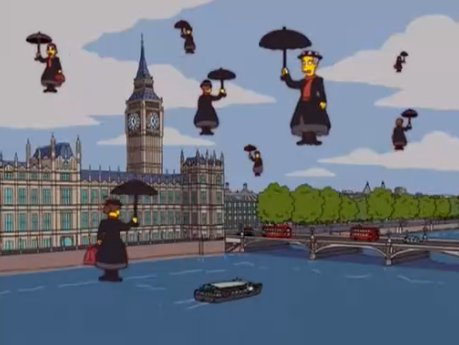
In this class, we learn about cultural diversity, and sometimes we learn about the History about countries like England.

But... The Simpsons are going in the foward, because with their chapters we can learn about Cultural Diversity and History, and we don't know that we are learning!!! It's something too incredible!!
  The Simpsons are always showing stereotyopes of a country, people, etc. But today I will show to you about England and the last class.  In the last class, we learn about Elizabeth Queen History, but in the middle of the class I remember that I learn about this class in other place...Then I thought: In The Simpsons!! 
 Homero was Enrique VIII, and he was unhappy because he can't get divorsed of her wife by the Catholic Church, so, he decided create the "Igloesia Anglicana", and he get divorced 6 times, and he has got 6 wives. The next par of this history is your dutie. I will leave the link, because I relly want to search with you my way to learn something.


http://www.lossimpsonsonline.com.ar/capitulos-online/espanol-latino/temporada-15/capitulo-11

I really want that you watch this chapter. You will laugh a lot!!
Other Thing that I didn´t wrote, is the Cultural Diversity in the different chapters, I recommend you watch The Simpsons If you want to learn about History in a different way.
I think, that The Simpsons is a really intelligent TV show, because this program search the way how to make conscience between people, and make us think about the thi

ns that are happening in our world.
I HOPE YOU ENJOY THIS TV SHOW!!


Rastafarian Movement

 I have only one ambition: to see humanity all together, blacks, whites, everybody living together.                                             Bob Marley.

The Syncretism there are  a culture mixture. One of the most important Syncretism is the Rastafari Religion which is a socio cultural movement, it mixes elements from the Bible, Pan africanism movement and Caribbean culture. 
When I hear Rastafari one of the thing that comes to my mind is the Dreadlocks and reggae music. But The Rastafari movement is more than this. 
The Rastafari is one lifestyle, its a espiritual philosofy based on the revolutionary essence of the Peace and Love , one different form to see the creation. 
This revolutionary movement was created in Jamaica, in the XVIII century but it makes strengths in 1930 when Haile Selassie was proclamaited King of the Ethiopia  who was to the Rastafarian people like the black Messiah.


One of the most important represent of the Rastafarian Movement is the Singer Bob Marley who with his music to develop the Peace and Love, the union of the people. 

 Check this link about the  Bob Marley's mysticism and the Rastafarian Movement. http://www.youtube.com/watch?v=EHGqPh370sc

Ireland: A country rich in culture

How much we know about the culture of the country whose symbol is the clover and green goblin?

The Irish are very charismatic, in the street they greet all but at the same time, do not support demonstrations of affection in public. But what do we know about the dance jumps and the typical Goblin both representing them?


  There are two types of Celtic dances, the set dancing and step dancing, there are two types of dances. The set can dance it any person, independent of their capabilities, on the other hand, the step, has ancient roots and is the most complex form of Irish dance popularized in the 1990 thanks to the Riverdance ensemble, and later to show Lord Of The Dance. Therefore, experienced dancers represent this dance.


St. Patrick's day is celebrated on 17 March to commemorate their employer bearing the same name. 

  A Christian tradition says that Patrick explained the mystery of the Holy Trinity using a three-leaf clover. So that day has been established as usual wear a Shamrock in the celebration of his feast. It is also common dress in color green and even dye with this color the beer in honor of Ireland, also nicknamed the 'Emerald Isle'.


The parade of the day of Saint Patrick in Dublin, capital of the Republic of Ireland, part of a festival that lasts five days and more than 675,000 people attended it in 2009.
A fundamental part of the feast of St. Patrick are numerous parades that take place in different parts of the world. From small towns and villages in Ireland and Ireland of the North to the big parades in New York, the largest in the world dedicated to St. Patrick, in which participate in one way or another hundreds of thousands of people each year. Other cities with major celebrations in honour of the Irish patron are London, Montreal, Chicago, Paris, Toronto, Buenos Aires or Manchester, among others.


The Celtics in our classroom

It's been arround 2 months that we started our first year in the university (most of us), and certainly, there hasn't been any work that was neither funnier nor spectacular as the maps exhibition.


Our job was simple, but complex at the same time, work in groups to prepare a physical representation of a certain region of the English speaking world. My region with my group of course, was the Celtic Fringe. (see the leprechaun? yeah, those people... kidding)

Well, our mission was to talk, give a representation, and inform the other clasmates about the different countries that surrounded the Celtic culture, such as Wales, Ireland, Scotland and Cornwall... well, Cornwall isn't exactly a country, but it's a region with it's own language, so it does fit in the group.

Me and my other classmates divided the work in 13 total points, those included weather, organization, languages, lifestyles... a lot of things! everything possible so everyone could understand everything about the Celtic Fringe.

We, as a team, also learned a lot, we discovered (well, I did at least) the fact that Cornwall isn't actually a country, every single region speaks English in some degree, and everyone follows a same pattern of social reverences that show the fact that they've always kept their essence as Celtic.

We (now all of us) learned a lot about the religions that appear as predominant in the regions, we also learned about each of the region's political administration, for example, Ireland has it's own president, while all the other ones have a first ministry and are under the jurisdiction of the UK, all while keeping their common culture, wich is the Celtic.

But yeah, our main goal was to show our classmates everything we could about the Celtic Fringe, and to see how our own classmates react to the fantastic world of the Celtics. How each and everyone of them understood it, it's up to them, but other than learning the fun about the multidiversity that can be found in a region like the Celtic Fringe is amazing, and I hope all of them catched that part at least

Finally, the geography is beautiful, everything that involves oceanic weather with tons and tons of hills, not to mention mountains, is amazing. In general, the Celtic Fringe has a lot of lakes and rivers that are well known, like Lough Neagh, wich is the biggest of the whole UK or the Loch Lommond, wich is the largest Natural one.

But yeah, the Celtic culture is amazing, I hope we can work with it more often!

Thursday, May 1, 2014

Bloody Mary

Mary I , was queen of England and Ireland from July 1553 until her death. Her executions of protestan caused her opponents to giver her the sobriquet "Bloode Mary". This part of the history caught my attention, because in her reig, killed 300 protestans, for this reason i want to search more about her. And this i what i found:

His intention was at all times to restore Catholicism in England, she abolished many of the laws promulgated by Edward VI and imprisoned the Protestant bishops. In 1554 she married Philip II, heir to the Spanish Crown and son of the Emperor Charles V, who hoped to establish an alliance with England to isolate France .

During his reign he suffered two false pregnancies, so it was speculated that it could be due to the pressure to create an heir. His death occurred November 17, 1558 in St. James's Palace. While his testament was collecting his will to be buried next to his mother, she was finally buried in Westminster Abbey, who would later share with Isabel I.

I think that this Queen was a very strong woman, and I think that no one could make her change of opinion".